Friday, September 14, 2018

The Davenports


“If you want your horses fed, feed them yourself," replied ten-year-old William Davenport to Tory leader John McFall in September of 1780. Channeling his father's courage he would become a leader in his own right as he grew older.  The Davenport College for Women in Lenoir, NC was formed through his philanthropy.

John McFall served in Major Ferguson’s 1000-man army in the mountains and helped to subdue the rebel element there.  All through the mountain back country Ferguson’s men would search for the patriot militiamen and turn their wrath on rebel families when the men folk were not at home.  The women and children were turned out and the property was destroyed.  With nowhere to go, these refugees of liberty were found wandering and living off the land with bare clothes upon their backs. 

A poor and emotional sight that would help induce the back-country inhabitants to rise up against the Brits.

McFall and his men had rushed the Davenport home near Wilson Creek at the John’s River in search of Captain Martin Davenport of the Burke County militia.  The good Captain was off serving in the field so McFall forced Mrs. Davenport to feed his band of Loyalists.  When young Davenport boldly refused McFall’s demands and took up his father’s independent spirit, McFall whipped him. 

McFall would pay eternally for his misstep and swing from the hangman’s noose during the time of reckoning a few weeks later.(1)

A few years after the war the Davenport’s moved further up into the mountains off the Toe River.  Captain Martin Davenport sought freedom and independence in the solitude of the mountains just west of the Linville caverns.  He would become a hunting guide, an entertainer to foreign guests, protector of the poor and a coroner.(2)
 
The young William Davenport would become a prominent member of the community around Lenoir as well.  He was a magistrate, State representative and State Senator.  The Davenport Women’s College was his namesake and the buildings upon that hill still house an elementary school as well as the Caldwell Heritage Museum.(3)  Freedom Reigns!


(1) King’s Mountain and It’s Heroes: History of the Battle of King’s Mountain, October 7th, 1780, and the Events Which Led to It, Lyman C. Draper, Anthony Allaire

Wednesday, September 12, 2018

the McDowells


In September of 1780 British Major Patrick Ferguson raised his army of over 1000 men and headed up into the North Carolina Mountains. Going through present day, Chesney, SC and onto Rutherfordton, NC., his army would live off the land as they worked their way from community to hamlet. On the general route laid out by the old Hwy 64 in NC., they rousted leaders and families to subdue the rebellion.

Ferguson had missed Colonel Isaac Shelby who had already made good his retreat over the mountains. But the left-wing commander of Cornwallis’ army had caught the scent of NC militia Colonel Charles McDowell and his force of about 160 men. McDowell was headed for the Watauga river valley in Tennessee, which is northwest of the present-day Beech Mountain snow resort of North Carolina.

Charles and his band of warriors had gone into South Carolina to stall Cornwallis and lend aid where they could.  McDowell was a prominent man in his community and he and his wife manufactured gunpowder in the Quaker Meadows of Morganton, NC.  McDowell had been appointed as a Colonel in the Burke County, NC militia and his brother, Joseph (a Major), served under him in all their military engagements. 

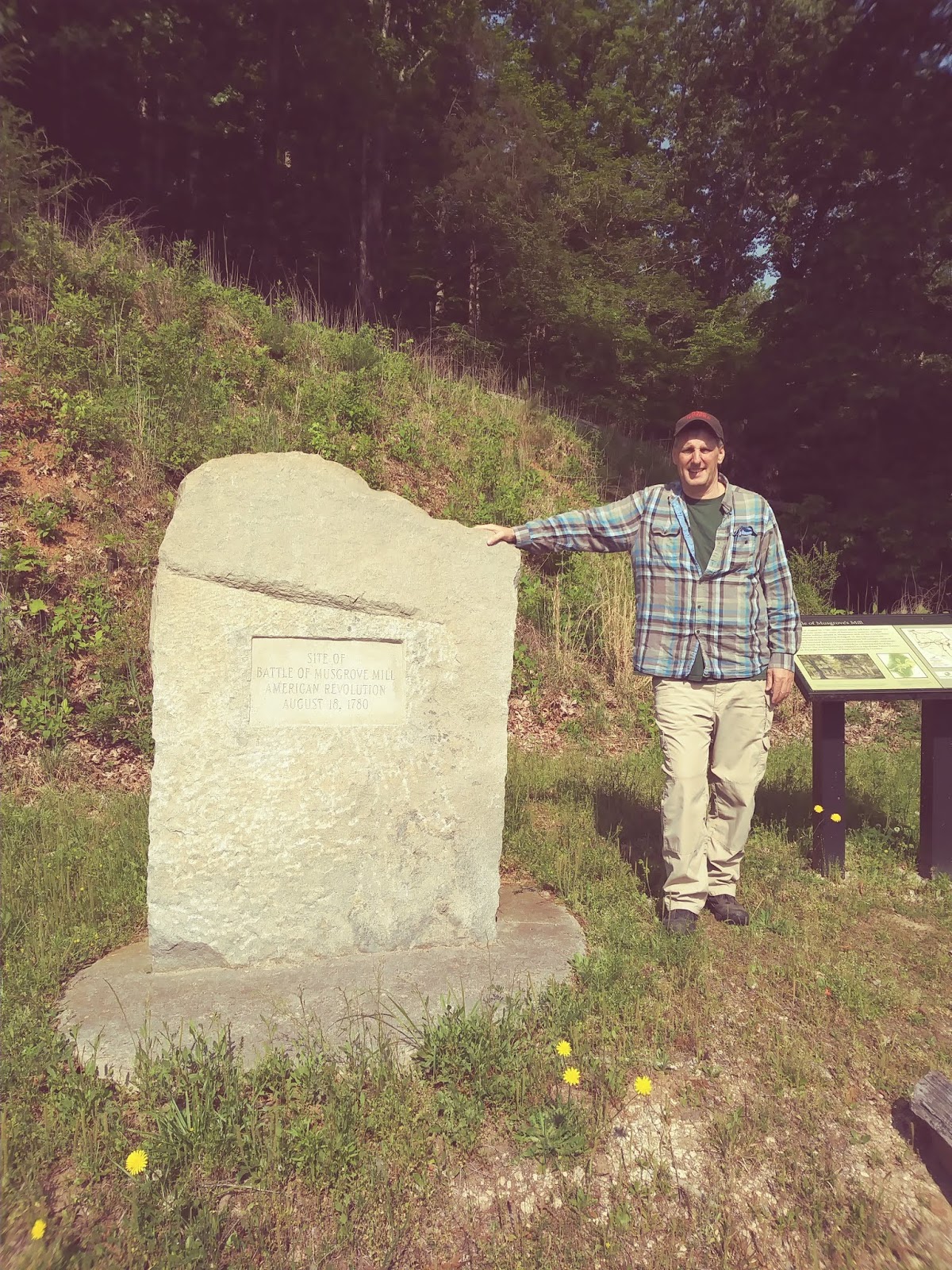
They had hoped to battle the King’s men in South Carolina and keep them away from their homes.  Colonel McDowell had sent out forces that won at Fort Thicketty and Musgrove Mill and the McDowells had done their duty and given aid and sword wherever they could.  Now they were on the retreat. (1)

As brothers they were a force to be reckoned with.  Where one, Charles, had the confidence of the local leaders; the other, Joseph, was a true fighter who inspired the men from Burke County and beyond. 

When Ferguson marched up old Hwy 64, the McDowells were ready for him at the headwaters of the Cane Creek.

The Patriots, though outnumbered, had laid an ambush up on the high ground and challenged the Lobster backs, led by their British Major.  On September 12, 1780 Patriot shots were fired from concealed positions and the Loyalists recoiled from the initial surprise, but they rallied.  With rifle and bayonet, Ferguson’s men began to make headway toward the Patriot lines up the hill. 
 Joseph McDowell

Joseph McDowell was heard swearing and yelling for his men to stand and die with him if need be, and that he would never yield!(2)  Rifle fire would mix with yells, screams and smoke in that shadow of the South Mountains. The Patriots fought for time and freedom to make good their escape.

The Brits only left the field after they claimed victory, but they came up short in the fray. Bones from the fight were still found four decades later, strewn across the battlefield. These remnants of the dead seemed to belie the viewpoint of victory that Ferguson’s men professed.   In the end, both sides lost men. 

But the McDowells were able to make good their escape. The Brits made their way back to Gilbert town with an unknown number of dead and wounded. Among the wounded was one Captain James Dunlap, a veteran of the Queen’s Rangers and leader of a troop of Loyalist mounted riflemen. Out of action for some time and convalescing from a serious wound to the leg, he would not see action again with Major Ferguson.

Dunlap was sheltered in a Loyalist home and could not move with the army.  He would later be shot by the Patriots seeking revenge for the death of Noah Hampton in South Carolina. His attackers failed to make sure he was dead, though, and he dodged their attempt to end his life. Rumor, lies and a false grave were utilized to stay one step ahead of his pursuers.

Perhaps the most telling result of this “check” by McDowell on Ferguson was what happened in the next few weeks.  Word got out to the countryside of the intrusion of the King’s forces into the mountain regions. In a short time, Ferguson begins to hear that an army of mountaineers are coming like a fog out of the high valleys across the Blue Ridge.  Coming for him!  

A Reckoning was coming!  Freedom Reigns!

(2)King’s Mountain and Its Heroes: A History of the Battle of King’s Mountain, October 7th, 1780, and the Events Which Led to It., Lyman C. Draper, Anthony Allaire


Tuesday, September 11, 2018

The Twin Poplars

The Twin Poplars of Peace

Local legend has it that over 280 years ago the Catawba and the Cherokee Indians were locked in a brutal and savage conflict in the smoky hills around Lenoir, North Carolina.  So many warriors were killed on both sides that the leaders came together to talk peace, not as victor over vanquished, but as equals.  Distrust an enmity were conquered and peace was made..at least temporarily.  The symbol of that peace would be two trees and their ability to grow together.

Written language was an unknown to these fearless people on both sides. Sequoyah did not develop the Cherokee written language until over 70 years later, consequently there is no known text of this conflict and treaty. The historical record from our own Revolution seem to at least confirm the opposing relationships between these two tribes. The Cherokee aligned with the British and the Catawba fought alongside of the Patriots almost 40 years afterward.

Near the headwaters of the Catawba River we find road signs like Warrior Rd., Twin Poplar Ln. and Indian Grave Road that seem to memorialize what the history books do not.  Boone NC beckons the modern-day traveler, but coves cut into the mountains just off of Highway 321 harbor the stuff of local folklore. 

The war ranged all through these coves and valleys. Some of the burials are rumored to have occurred in the caves that are shared by bear and coyote to this day. Dirt roads now cover the foot trails and hunting paths from the past.  Black top and development roll over the creeks and crevices where the warriors would drink and hide. Private land with title and tax have replaced the free range of the Indians of a bygone era.

With the energetic and knowledgeable help of Cindy Day, the Director of the Caldwell Heritage Museum, and her equally magnanimous colleague Lisa Ward, the Twin Poplars were found rising  like ancient pillars in the secluded local lands.  With each cautious step down the wet and steep terrain, we were transported back in time. 

The mountains in this part of the country breath and give off a haze that paint the landscape blue as the peaks rise with a smoky mist.  The trees were draped in this phenomenon as we made our way to their base.  Nature would paint a sacred picture to this cathedral of peace and lend itself to bolster the story even more.

The Legend of the Twin Poplars suggests that the leaders of this ancient and violent war came together and tied two poplars as a symbol of the peace.  If the poplars were to grow together, then their peace would survive. 

To the naked eye it does appear that the bases of each tree, separated as they are, have their own individual root systems.  Their trunks being so far apart, it would seem implausible for them to have grown together without some artificial help from man.  Whether that help came from the indigenous tribes of yesteryear or some farmer thereafter is but speculation.


When hurricane Hugo came through in 1989 much of the forest was decimated by the high winds that swept up into the mountains from the coast.  Old growth trees were a natural victim and many feared that the twin poplars would not survive.  As the curious probed the deadwoods after the storm they rejoiced to find them still standing tall and proud.

We may never know if the Legend of the Twin Poplars is fact or fiction.  It is certainly, though, a story of folklore that resonates within us and causes us to reapply ourselves to the convictions of peace and harmony.  Their natural appearance in the wood certainly gives majesty to our walk upon this earth and heaps credit on the Creator for His good work.  Whatever the origin of their union, these ancient poplars and their union are a natural monument to the better parts of our human nature.


Tuesday, September 4, 2018

Isaac Shelby


Isaac Shelby was definitely not a “fence sitter” during the war with the mother country.  He was, as a son of his father Evan Shelby, a proponent by deed of the Fincastle Resolutions and had resolved to "live and die" while never surrendering his "inestimable privileges".(1)  He understood Freedom and slavery.  He understood the Quebec acts as intolerable to his Protestant background, his sense of justice and his rights as a citizen to have a say in how one is governed.


Later in life he would be called “Old King’s Mountain." 

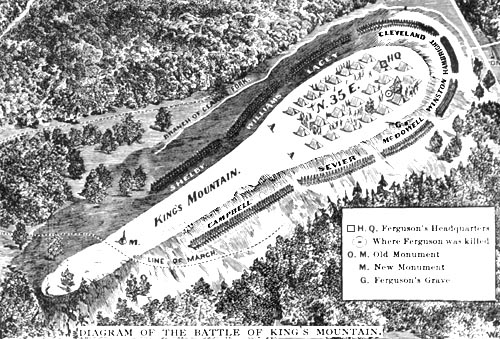
He won that nickname at the age of 29 on the wet, steep hillsides of King’s Mountain. There, British Col. Patrick Ferguson waited for his approach. Along with Shelby came over a thousand Patriot warriors from Over the Mountain.  


Ferguson had a poor view of Shelby and the Over the Mountain men.  In his mind they had run from him at Wofford's Iron Works (Battle of Cedar Springs) in Spartanburg. The band of rugged Patriots had taunted the King's men from a hill and led them on a merry chase that left Ferguson frustrated.


The British leader also considered them a group of thieves who had settled in the lands off limits to British subjects.  

Having just missed Shelby and the others at the battle of Musgrove Mills on August 19th, 1780, he set out in pursuit towards Gilbert Town, near present day Rutherfordton, NC.  


Ferguson was seeking a fight and
 grew more confident as the Loyalist poured into his camp for safety.

His letter to Cornwallis revealed a positive attitude towards the number of loyalists coming into camp. Ferguson then made ready to gather more supplies and search for cattle to feed his growing army. (2)


But Ferguson was unaware that he was being tricked and was in a chess match with his betters. Shelby, along with his fellow leaders at Musgrove Mill, convinced the inhabitants of the mountain regions around Gilbert Town to take shelter under the King's protection. By doing this they would be able to save their cattle that they had hid away in the mountain passes for the Patriot cause.


Ferguson's soldiers sallied forth out of camp in search of beef among the Patriot farmers.  Finding a herd they began their work of preparing the meat for the meals.  As they were well into their work, Ferguson was informed that they had been decimating the herds of three of his own loyalist men.  Ferguson had been duped by Colonel Shelby and British influence in the area suffered even more.


About that same time, Colonel Ferguson paroled an Over the Mountain prisoner in his entourage and sent him with a message to Isaac Shelby in particular.  Samuel Philips found Shelby and relayed the message, "If they did not desist from their opposition to the British arms, he would march his army over the mountains, hang their leaders, and lay their country waste with fire and sword."  Philips, ever the soldier, then set about giving particulars on the makeup of Ferguson's army to Colonel Shelby.


Shelby and the leaders at Musgrove Mills had foreseen that Ferguson had plans for their mountain homeland even before he had left the South State.  They had agreed to begin recruiting an army to confront Ferguson as soon as the opportunity presented itself. Now was the time. 


Shelby would take the lead and find John Sevier and other leaders and start towards the invading army.  Dispatches and messengers were sent throughout the mountains.


They came in droves.  Hundreds from different counties and valleys converged on the meeting places in Morganton and Gilbert Town.  They came, on horseback and on foot, with a purpose to confront the threats of Colonel Ferguson and the British realm.  These were wild hunters of hearty stock who understood Freedom and self government.  They were armed with rifles and were expert marksmen. They came over the snow covered mountains and down through the valleys.  They forded mountain streams and rivers while keeping their powder dry.  They came on knowing that they might not come back.  They came in droves. With Colonel Shelby....They came for a Reckoning!


Ferguson, at first, did not comprehend his peril. He allowed his personal biases to not see his enemy for what it was...a battle-hardened foe led by Colonel Shelby (and others).  He either couldn't or wouldn't see that Shelby was neither awed by British might nor one to lose a fight.  Colonel Ferguson lingered, hoping to cut off Georgia Patriot Col. Elijah Clarke coming from Augusta, Ga. He would wind his way back down the mountain passes, stall for a little more time for Clarke to appear.  The Redcoats would then feint southwest towards Ninety Six and ultimately head east to draw on support from Lord Cornwallis. Clarke never showed, but Shelby and company came on with a purpose and closed the distance.


Cornwallis was easily within reach at Charlotte, NC had Ferguson simply been prudent. But Ferguson chose the small mountain spur of King's Mountain to make his stand.  He had trained and bragged about his group of Loyalists in his camp and now that confidence would be tested. Ferguson trusted in his position and his loyal troops numbering close to 1000 men at arms.  He would even boast about his chosen defensive position and swore it could not be taken.(3)  


After being on the march for 2 weeks, Colonel Shelby made sure the British threats were answered. On October 7, 1780 the Mountain men surrounded the summit and were urged to do their duty; and if they did, the day would be won.

Image result for isaac shelby

Drawing on his experience fighting the Shawnee, Shelby would tell his men at King’s Mountain, “Be your own officer...If in the woods, shelter yourselves, and give them Indian play; advance from tree to tree, pressing the enemy and killing and disabling all you can.”(4) 

The battle raged for just over an hour and Ferguson was left dead on the field.  His words to Colonel Shelby had inflamed the Patriot zeal and left the British leader cold and prostrate.  Shelby, by contrast, stood erect, unscathed and was every bit in control of his men and his duty.


After the battle of Kings Mountain and before the march off the precipice, the prisoners were ordered to line up and shoulder rifles that were stacked. An elderly loyalist of King George feigned old age as a reason for not picking his up.  Shelby slapped him with the flat edge of his sword and said, that he(Shelby) had brought one so the tory could take one away.  The tory jumped to, grabbed a rifle and got into line.(5)

In 1781 Shelby would fight under Francis Marion and add more wins to his war record.

He would later become the first and fifth governor of Kentucky and serve in the War of 1812.(6)

Fearless, determined and able, Colonel Shelby was one of the many heroes of King's Mountain and the Revolution in the South.  He was followed and feared in the cause of Liberty all throughout his life and the Country owes him great respect and gratitude.

Many towns and counties were named in his honor, including the North Carolina city just north of Kings Mountain.  Freedom Reigns!

(3) Before They Were HEroes at King's Mountain, Randell Jones
(4) The Battles of Kings Mountain and Cowpens: The American Revolution in the Southern Backcountry, Melissa A. Walker
(5) History of the Upper Country of SC, Logan

Thursday, August 30, 2018

Juniper Springs June 18, 1781


A man and a horse do not a cavalry make!  A lack of swords was a serious problem for Revolutionary war era cavalry, and on June 18, 1781 the Patriots got the worst end of their encounter with 200 British mounted infantry in Gilbert, SC.  After this running battle from Highway 1 down Peach Festival Road, Patriot Colonel Charles Myddelton’s troops were scattered and demoralized.

These were men under General Sumter who were sent to follow and harass Lord Rawdon's troops. Rawdon was on the march to the fort at Ninety Six; which was being besieged by Nathaniel Greene and 1600 Patriots.   


The British regrouped at Vaudant’s Old Fields before continuing their march north.  Here they buried 4 of the King’s men and 4 Patriots.  They also hung 2 of their own from a nearby tree. Their corpses swung in the wind for three weeks until a farmer happened upon them, cut them down and buried them along with the others.  

The graves of the these unknown soldiers can be found in a corn field on Cedar Grove Rd. Silent markers of stone sit upright like Cypress knees to mark the earthen beds of the fallen.  Poor monuments to the conflict and the men who helped win our Liberty.  


Greene's strategy of attrition was working.  The British ultimately abandoned Ninety Six and consolidated their forces in Orangeburg.(1)  Freedom Reigns! 

(1) Parker's Guide to the Revolutionary War in South Carolina, John C. Parker Jr.


Monday, August 20, 2018

Battle of the Great Savannah

The Battle of the Great Savannah


Perhaps the greatest single order that General Gates gave prior to his ignoble defeat at Camden was to appoint Francis Marion as the Brigadier General of the South Carolina Militia.  

Following up on his orders, Marion departed from Gates at Rugeley’s Mill above Camden. He then headed south to raise a Brigade of militia and play havoc on the British supply lines.  

Gates  was preparing for his appointment with Cornwallis.  

While burning boats and raising an army on his way towards the Santee, Marion learned of Gate’s demise on August 16, 1780.  He declined to tell his men in his command in the hopes that they would not quit the mission. 

After the battle of Camden the British began marching prisoners in groups of 150 to Charleston along the present day Old State Road 261.  (The King's Highway is the by-way of old that ran from Charleston to Camden.  It cut through the High Hills of the Santee, which was a hideout and way-point for Patriots under Sumter and Marion.)


The British decided to stop for the night at Sumter’s plantation before heading on to Charleston (Sumter having fled to Charlotte after his defeat at Fishing Creek)

General Sumter’s plantation, during the Revolution, was across from Nelson’s Ferry on the Santee River in Clarendon County.  It now lies at the bottom of the man-made lake and is occupied by all sorts of marine life; including but not limited to the alligators.  The closest that one can get to the site of the battle (short of scuba diving) is to explore the Santee National Wildlife Refuge.  Fort Watson is nearby and offers the history buff even more to discover and learn.
   
The Red Coat guard of 38 soldiers rested and stacked their arms for the night, feeling confident in their wins against Gates and Sumter and believing the area was secure so far behind the lines of conflict. 

Marion and Major Hugh Horry approached the house on August 25th.  A sentry fired a shot and the skirmish commenced with Horry and his men taking the front of the house while Marion and his men rushed the rear.  When the smoke cleared and the yelling had stopped, 22 British were killed or captured.

However, these Continental soldiers of the Maryland and Delaware lines were not willing to be freed.  Marion and his men must have been dumfounded when these men chose to continue as prisoners. Most of these soldiers, despite the mismanagement of General Gates, had fought bravely under DeKalb at Camden.  In a letter to Governor Rutledge, General Otho Williams would write,  “Of the 150 men retaken by Marion only about 60 rejoined their corps -- some were sick but most of them just departed."


For the British, Camden was a gift that kept on giving. 

It is a dire situation when the State militia launch a battle to free their fellow Patriots, only to realize they don’t want to be rescued. 

These were times that tested men’s souls.  Slavery or Liberty.  Servitude or Freedom.  Serfdom or self-government.  These hung in the balance in August of 1780 in South Carolina. Here, high minded speeches and thoughts of Freedom met bullet and blade.  

Along the back-roads over grown and passed by, the government that we now take for granted was born in the cauldron of despair.  Patriot fervor waned at the fall of Charleston, and was almost snuffed out at the defeat at Camden.  All along the frontier  (at Ninety Six, Camden, Cheraw, Hanging Rock, and Rocky Mount) loyalists were swooning over the arrival of Cornwallis, Tarleton, Wemyss and Ferguson.  Many a Patriot quit and resigned themselves to the fate of the conflict.  Merchants in Charleston and Savannah were filling their coffers with English coin from British contracts.  The Southern Strategy was working and it would be a matter of time before Britain was master of the colonies once more.

Or so they thought.
 
Marion was in the field.  Sumter had escaped.  A secret army was being raised.  

A reckoning is coming! Freedom Reigns!


Parker's Guide to the American Revolutionary War in South Carolina, John C. Parker Jr.


Monday, August 13, 2018

Musgrove Mill


Ferguson was frustrated.
 
At the Battle of Wofford’s Iron Works (Spartanburg) on August 8, 1780 American Col. Isaac Shelby and his frontiersmen played cat and mouse with Cornwallis’ man and eluded his British force with taunts and jeers on a hillside out of musket range.(1)  This came just a little over a week after Loyalists surrendered to Col. Shelby’s Indian fighters at Thicketty Fort without firing a shot.
 
That frustration would mount as on August 19th the Patriot bands of warriors under Shelby, SC militia Col. James Williams and Patriot Col. Elijah Clarke slipped in behind Ferguson's lines during a night-time ride and engaged Loyalists at Musgrove Mill (present-day southern, Spartanburg County) that morning.  The American Revolutionaries numbered about 300 men at arms. 

After halting in an open Indian field about a mile from the Ford of the Enoree River, scouts were sent out to gain intelligence on the enemy just before dawn.  Shots were fired and the scouts, though some wounded, made it back to camp and reported enemy numbers to be over twice the anticipated force of 200.

Sometime during the night reinforcements, intended for Col. Ferguson, had arrived at the British camp and were anticipating joining up with the left wing of the Red Coat army on their march northward.  Among these in camp at Musgrove Mill were two hundred Provincials from New York under the command of Colonel Alexander Innes.  

Shelby was outnumbered, his horses were spent, and his enemy would be reinforced by Ferguson soon. 

Shelby needed to draw again from his tactical skills forged in the furnace of Indian wars.  He chose to fight. He ordered his men to build breastworks of fallen logs and brush across the expanse of the open field in a rough semi-circle.  His plan to use cover and concealment during the battle would equal the playing field to the benefit of his men, as the British would be attacking a more fortified position without cover of their own.  Shelby and his contingent of frontiersmen under the bold Josiah Culbertson were on the right. Williams and his South Carolina militia were in the center. Clarke’s courageous Georgia troops were on the left.  Reserve troops were within earshot and hidden nearby; while the horses were staged in the rear.

The trap was set.

Now for the bait.
Looking up towards the British encampment
British Colonel Innes urged his reluctant peers in the war council to make haste and give fight to the rebel band who he had little regard for.  Some in the council wished to finish their breakfast and wait for Ferguson, but Innes was insistent.  As they made ready, Patriot Captain Inman and 25 men sallied in towards the King's camp and fired at the British from across the river, enticing them to give chase.  Innes did not hesitate nor disappoint.  

Innes’s whole force, save one hundred in reserve at the house, followed down and then up the hill on the heels of Inman and his party of Whigs; whom they believed represented the whole of the rebel band.  Unknown to them, Josiah Culbertson's party were concealed on their flank as they moved up the hill.(2)  The loyalists, answering the bugle calls, drums and shouts of their leaders, formed up and advanced to within 70 yards of the breastworks, bayonets at the ready.
Looking up towards the Patriot breastworks
Suddenly a deadly accurate fire was unleashed at the British just when they had let out a “Huzzah for King George!”  The attacking British staggered but for a moment.  They checked their lines and resumed their march.  Disciplined and steady, they came on with bayonet and determination.  The Patriot riflemen were much slower in their reloads than the British soldiers and their muskets. To make matters worse, the British cold steel was pressing in.  These anxious moments were observed by Shelby and Clarke and orders were given with haste.

The forty men in reserve were called up and filled the ranks of the riflemen who were being pressed hard.  At this critical juncture, Colonel Innes was killed by one of the Over the Mountain men and in the ensuing moments the tide changed for the advancing British.  

The frontiersmen let out an Indian war cry and rushed into the fray of smoke and powder and into close quarter combat.  The screams, the gun fire and the battle yell of charging wild warriors were all mixed with the smoke that made it impossible to see beyond 20 yards.  

The loyalist militia in front of Clarke gave way and began to fall back. Soon it was a full-blown retreat as the British ran back down the road from which they had come.  The dead and wounded lay scattered along the route as the Patriots were in hot pursuit and continuing to engage their enemy, even into the river ford.

One of the Tories, still bold despite the retreat, decided to drop his trousers and show his mooned cheeks to his pursuers as he made his way up the opposite hill.  He was paid in full with a bullet to his pasty white backside and carried off in shame and discomfort.(3)

In just about an hour of heavy fighting the smoke clears, and Shelby is the victor.  He has now beat the enemy three times in the field under less than favorable conditions, all within 3 weeks time. 

The victory is short lived as an express rider comes in from Colonel Davie at the Waxhaws informing the victors of the defeat of Gates at Camden, SC. 

Davie, who was riding to help in the battle at Camden, had observed Gates fleeing northward. Davie adjusted his own orders and turned back. He then prudently sent out messages to leaders still in the field, to include Thomas Sumter and Shelby's command structure.  Sumter suffers defeat at Fishing Creek above Great Falls, SC and flees to Charlotte.  Shelby and his army dispersed and seemingly vaporize into the mountains with their prisoners above present day Rutherford, NC.  The reality is Shelby would not let them rest till they were safely in the mountain passes and many of his warriors were starving and fatigued when they got home.
 
As Ferguson arrives too late to assist in the battle it is evident that Shelby has eluded the British Colonel once again.  His subsequent pursuit into the North State is met with equal results.(3,4)

But South Carolina is without a formal army to oppose the British and Cornwallis has his sights set on Charlotte and beyond.  Cornwallis sends Ferguson into the mountains where he imprudently threatens to lay waste to Scots-Irish Patriot homes and hang their leaders.  

General Washington sends Nathaniel Greene and Daniel Morgan south to raise an army and continue the fight.  

The Over the Mountain men begin raising their own army and are helped in recruitment by the bold and aggressive talk of Ferguson.

A reckoning is coming! 

Freedom Reigns!


(1)King’s Mountain and It’s Heroes: History of the Battle of King’s Mountain, October 7th, 1780, and the Events Which Led to It, Draper, Allaire
(2)http://sc_tories.tripod.com/battle_of_musgrove_mill.htm
(3)Before They Were Heroes at King’s Mountain, Randell Jones
(4)Parker’s Guide to the Revolutionary War in South Carolina, John C. Parker

Wednesday, August 8, 2018

Fishing Creek


Two ladies loyal to the King helped Tarleton put another jewel in his Crown while the “Gamecock” was saved by cattle, sheep and a low hanging branch.

On August 15, 1780, the day before Camden fell, Col. Sumter won at Cary’s Fort.  Guarding the Wateree crossing, Cary’s Fort was located on the west side of the Wateree River in the general area of where I-20 crosses it. After the battle “The Gamecock” Sumter had the task of transporting 100 prisoners, over 40 wagons loaded with supplies and 300 head of cattle (and sheep) north towards the State line.  Just on the other side of the river the Battle of Camden raged and was lost by Gates. 

Sumter was in a precarious situation and he posted a rear guard as they slowly made their way towards Charlotte, hoping to go undetected.  But Tarleton was sent by Lord Cornwallis to find his captured Loyalist men and supplies. Soon Tarleton and his Dragoons were able to observe Sumter’s camp fires from across the river.  They caught up with them on August 18, 1780 just north of the present-day Fishing Creek Dam off Hwy 21 in Chester County.  Sumter had managed to travel roughly 40 miles since his battle at the Wateree crossing.

Lt. Col. Banastre Tarleton’s Dragoons were in no mood to play nice. They had been riding, marching and fighting for days without rest when they came upon Sumter’s force of over 800 men.  Now they rode two to a horse to bring enough men to the fight.  Aided by information from two Tory ladies, Tarleton was able to know Sumter’s location and disposition of the rebel forces. These ladies of the Crown also informed him of alternate avenues of approach to the Whig camp by way of some secondary roads. 

They found Sumter and he had let his guard down!  Sumter had stopped to rest in the rolling green hills along the banks of the Catawba river just above the Great Falls.  The Patriot force had stacked their arms around noon and were bathing, eating, shaving and foraging. Indeed, some of the militia had found the rum in the wagons and were too drunk to fight.  Two of Sumter’s men guarding the rear approach of the Patriot force were found and killed by saber, without drawing attention to the British Legion’s presence.

Tarleton, extremely outnumbered, boldly charged with his 100 mounted dragoons, augmented with but 60 foot soldiers. Whether by design, wisdom or chance he had played upon the psychology of the Patriot loss at Camden just two days before.

The cows and sheep grazed away as the human conflict flared.  Sumter was caught by surprise as he was observed sleeping when the battle commenced. Sumter quickly took in the situation and yelled, "Let every man take care of himself!” Leaving his coat and boots behind he jumped on an unsaddled wagon horse and rode out of camp in a flash. Riding furiously through the woods he was knocked from the horse by a low hanging limb and lay unconscious for some time after the battle.  

Col. Bratton and a small band of Partisans fought valiantly as the rest of the militia ran in all directions.  

Tarleton quickly inherited the shackles of baggage and livestock that Sumter had been relieved of. He could not pursue his foe for fear of losing that which he had just liberated. He turned his attention to his prisoners and spoils and turned south. 

In the confusion of the round up and trek back to Cornwallis, several Patriot prisoners were able to make good their escape.   

While Tarleton returned to Camden with added jewels to his crown, Sumter limped to Charlotte to regroup.

Thus our “Gamecock” though beaten by two ladies, a keg of rum and Tarleton, was saved by cattle, sheep and a low hanging branch!

With Gates and Sumter whipped in a matter of days and all his supplies intact, Cornwallis felt pretty confident.  The British army seemed invincible.  But rumors were in the air of a Loyalist defeat to the west. It was an omen that would haunt Cornwallis and a harbinger of things to come!

Freedom Reigns!
                                 
                                            General Thomas Sumter


https://www.myrevolutionarywar.com/battles/800818-fishing-creek/
Parker’s Guide to the Revolutionary War in South Carolina, John C. Parker
Before They Were Heroes at King’s Mountain, Randell Jones
History of the Upper Country of S.C., Logan


Saturday, August 4, 2018

Heroines of the Upstate Revolution


Perhaps the story of British occupation is best taught through the perils of the women on the home front, especially those of the frontier settlements.  Forced to reckon with Indian raids and bands of outlaws, these were not the women of the genteel plantations in the parishes outside of Charleston along the Cooper, Ashley, Stono, and Wando rivers.  These women grew up in households that had survived and flourished in that dangerous land of the upstate of South Carolina far away from law and order.  Their lives had been forged in the fire of threats and the cold reality of life and death struggles.  So, when the British came with more of the same, is it any wonder that these bold women answered in like manner?

Martha Bratton stared down a sickle meant for her head and calmly spoke in defiance as the Red Coats demanded information about her husband.  The farm estate located off Hwy 321 south of York, SC was situated in the rolling green hills of the piedmont. Forests and brooks were boundaries of fields and tilled soil.  The wagon road, strewn with pine needles and oak leaves, wound down and then up again, across a good creek to the front of her small house in the back country.  Foot paths were worn along deer trails through the lush green canopies to neighbors and friends in this hamlet of partisan families.  It was along one of these hidden trails that word got to her husband nearby and he, and his militia, ambushed Captain Christian Huck (The Swearing Captain) at the Williamson’ homestead and caused the British troop to regret their threats upon his wife.  This stand against Huck and his band put an end to a series of attacks in Chester and York counties where several homes were burned and many people from the community had been killed.  On another occasion it is said that she blew up gun powder stored on her property and boldly proclaimed to the British, who were riding up, that she had done it in defense of her country.
Martha Bratton

Kate Barry was said to have been flogged by a Tory named Elliott, for not revealing where her Patriot husband was.  On her family farm at Walnut Grove in Spartanburg County she was an accomplished rider of horse and a pious Presbyterian. Her maiden name of Moore is still a namesake in the community to this day.  She was married in 1767 at 15 years of age to Andrew Barry, who had been a community magistrate and Captain in the local militia before the war with England.  Legend has it that she rode as a scout on horseback and swam swollen rivers in the dark of night to carry word of British troop movements to the Colonials.  In her 20s during the time of the revolution, she was the darling of her husband’s band of Rangers. She was instrumental in rallying the Patriot militia to assist General Morgan at Cowpens where the battle was won.  At the end of the war her husband’s troop wanted justice for their lady of Liberty and urged Captain Barry to seek retribution against the man who had whipped her. He found Elliott hiding under a bed and, in the end, dropped him to the floor with a three-legged stool.  He then walked away proclaiming, “I am satisfied, I will not take his life.”  Kate and Captain Barry raised their children near her Walnut Grove after the war.  One of her descendants is Amanda Blake (Miss Kitty) from the TV show “Gunsmoke”.
Kate Barry

Mary Dillard, in like manner, is said to have swam the Enoree river to warn General Sumter of the British order of attack at the Battle of Blackstock’s.  This information came to her after she had been forced to feed the British troops invading her home. Perhaps because she was just a small woman who stayed in the background or because the British felt strength and security in their numbers, talk of the impending order of battle flowed freely at the table.  Realizing the information was vital and the lives of her family were in peril, she snuck away in the night from the farm and rode bareback on her horse to General Sumter’s camp, 20 miles away.  Her toddler child had to be tied to the bedpost while she ran off into the night.  During the battle it is reported that she untethered the British horses and marched them away from their masters and into the Patriot camp, thus further hampering the Red Coat plans.  After the defeat Tarleton believes the battle was lost because of a woman that was seen spying on them across the river.  Fearing for her children’s safety, she came home to find the house burned, though the children had been taken to the neighbor. The burned home was a scene that would repeat itself before the wars end and would place an exclamation point on the hardships of the times.
Mary Dillard

Dicey Langston,15 years of age, in the dead of night walked and ran five miles and crossed a swollen river to warn her brother’s Patriot band that Loyalist Bill Cunningham was in the area looking to kill them.  Laurens County was a loyalist stronghold and she and her aging father were surrounded by Tory neighbors always watchful for her Patriot brother.  Ever the fierce one, she was retrieving a gun hid for her brother when men showed up to the house claiming to be of his company.  When she brought the rifle, she demanded the countersign given by her brother to test the validity of the men’s claim.  When they dithered and made a comment that it was too late as she had the gun in hand, she quickly cocked the rifle and boldly threatened the men.  The countersign was given, and laughter washed away the tense and potentially deadly encounter.  Later she bravely stood in front of a British pistol that was meant for her ailing father and pled for her father’s life.  Honest and brave, she was protector and Patriot in a time when youth and adulthood mixed at an early age.
Dicey Langston

These women Patriots lived a life in the back country of the Upstate of South Carolina where their whole families could be snuffed out by the war.  They walked a delicate line as daughters, wives, mothers, house keepers, cooks and community members that, in many cases was as dangerous as their Patriot husbands and brothers faced on the field of battle.  At least their men-folk had a fighting chance without the encumbrances of toddlers at their feet, questionable neighbors and opposing armies that come to call.
 
In the bloody civil war of the Revolution in South Carolina, sides had to be chosen and the families at the homestead were often the victims.  These women, and the women like them whose stories were never told, chose not to play the victim.  They chose independence over servitude.  They chose to fight! Freedom Reigns!

http://www.womenhistoryblog.com/2010/10/martha-bratton
http://newacquisitionmilitia.com/christian-huck-biography/
Parker’s Guide to the Revolutionary War in South Carolina, John C. Parker Jr.
https://american-revolutionary-war-facts.com/American-Revolutionary-War-Women-Facts/Catherine-Moore-Barry-Facts.html
http://legendsofthefamily.blogspot.com/2017/08/mary-ramage-dillard-wife-mother-and.html
http://www.sarrettsofgeorgia.com/dillardhistory4.html
https://www.findagrave.com/memorial/29696253/mary-dillard
King’s Mountain and Its Heroes: History of the Battle of King’s Mountain, October 7th, 1780, and the Events Which Led to It, Lyman Draper and Anthony Allaire
http://www.womenhistoryblog.com/2009/04/dicey-langston-springfield.html
http://www.diceylangston.com/womenofrevolution.php