Showing posts with label Patrick Ferguson. Show all posts

Monday, September 24, 2018

Benjamin Cleveland


Colonel Benjamin Cleveland was of the same bold character as Daniel Boone and found his most delightful pleasure in hunting rather than plowing. As a young man he was often found in the woods hunting and gathering pelts.

Two of his childhood friends were Thomas Sumter and Joseph Martin.  Sumter would later be known as the “Gamecock” in the struggle for freedom in South Carolina.  Martin would become the Indian agent for the fledgling new nation trying to curtail the Cherokee uprisings caused by the British in the back country.

Cleveland trekked off to Kentucky after hearing Daniel Boone talk with great admiration of the hunting lands.  He and his friends were robbed by Indians and sent packing on foot, back to the Watauga region around Wilkes County, NC.  After recuperating from his journey he marched back over the mountains to retrieve the horses from the very Indians that had stolen them.  In a show-down with the main suspect Indian, Cleveland narrowly escapes a tomahawk and a gunshot from the enraged guilty party.  He was able to ride away with the property reacquired and a feather in his cap of self-confidence.(1)

Cleveland would brag that his ancestor was the Oliver Cromwell who was renowned for his leadership of England.  Benjamin owned a copy of  "The Life and Adventures of Mr. Cromwell, Natural Son of Oliver Cromwell” and would point to it when making this claim.(2)  If one can speak of something and thereby cause it to be, simply by applied belief, then it is probable Benjamin Cleveland identified with the "bigger than life" persona of Oliver Cromwell. Cleveland’s intrepid spirit certainly was as bold as Cromwell; or at least the character of the biography, Cromwell’s son.  At close to six feet in height and weighing in at a solid 300lbs of big muscle, few would wish to dispute Cleveland's force of nature.

Cleveland’s men were brutal and confident.  Ever portraying an aura of wildness, some would wear Scottish Tartans and Kilts that they had taken off dead Highland Scot Tories at the Battle of Moore’s Bridge in 1776.(3)  They were rough men who mirrored the personality of their leader and were known to the Tories as “Cleveland’s Devils”.(4)

During the Revolution, Benjamin Cleveland was busy running about the upcountry of North Carolina with his men chasing Tories.  It was in the midst of this action when the call went out from Isaac Shelby and John Sevier to rally and meet Major Ferguson’s threats head on.  

Prior to the Battle of King’s Mountain, Cleveland made an impassioned speech to his men who understood life and death in their extremities. Matter of fact in its delivery, it spoke to the unfettered resolve of the men under his command.  “My brave fellows!  We have beat the Tories before, and can beat them again.  They are all cowardly.  If they had the spirit of men they would have joined your fellow citizens in supporting the Independence of this Country.  When engaged, you are not to wait for the word of command from me.  I will show you how by my example on how to fight.  I can undertake no more.  Everyman must consider himself an officer, and act on their own judgement.  Fire as quick as you can, and stand as long as you can without tiring.  When you can do no better, get behind a tree or retreat.  I beg you not to run away, but if you do make it a point to return to battle as quickly as possible, and renew the fight.”(5)

Born and raised into a mindset of independence and self reliance, he bravely fought his way in and out of battle.  His exploits reverberate in Freedom's call even today. He was a feared and revered and was one of the heroes of King's Mountain. 

After the war he moved to Oconee County, SC and is buried on private property near Westminister, SC off of Hwy 123. In the Madison community, close to the Savannah River, an obelisk bearing his name can be found near the Madison Baptist Church. (6)

Freedom Reigns!


(1) Before They Were Heroes at King’s Mountain, Randell Jones
(2) http://www.ibiblio.org/mtnivy/BAJ/crouch.htm
(3) Ghosts of Yadkin Valley, R.G. Absher
(4) http://colbenjaminclevelandchapter.org/colonel-benjamin-cleveland/
(5) https://www.josephmartinchapter.org/smartin.html
(6) https://www.findagrave.com/memorial/31176869/benjamin-cleveland

Friday, September 14, 2018

The Davenports


“If you want your horses fed, feed them yourself," replied ten-year-old William Davenport to Tory leader John McFall in September of 1780. Channeling his father's courage he would become a leader in his own right as he grew older.  The Davenport College for Women in Lenoir, NC was formed through his philanthropy.

John McFall served in Major Ferguson’s 1000-man army in the mountains and helped to subdue the rebel element there.  All through the mountain back country Ferguson’s men would search for the patriot militiamen and turn their wrath on rebel families when the men folk were not at home.  The women and children were turned out and the property was destroyed.  With nowhere to go, these refugees of liberty were found wandering and living off the land with bare clothes upon their backs. 

A poor and emotional sight that would help induce the back-country inhabitants to rise up against the Brits.

McFall and his men had rushed the Davenport home near Wilson Creek at the John’s River in search of Captain Martin Davenport of the Burke County militia.  The good Captain was off serving in the field so McFall forced Mrs. Davenport to feed his band of Loyalists.  When young Davenport boldly refused McFall’s demands and took up his father’s independent spirit, McFall whipped him. 

McFall would pay eternally for his misstep and swing from the hangman’s noose during the time of reckoning a few weeks later.(1)

A few years after the war the Davenport’s moved further up into the mountains off the Toe River.  Captain Martin Davenport sought freedom and independence in the solitude of the mountains just west of the Linville caverns.  He would become a hunting guide, an entertainer to foreign guests, protector of the poor and a coroner.(2)
 
The young William Davenport would become a prominent member of the community around Lenoir as well.  He was a magistrate, State representative and State Senator.  The Davenport Women’s College was his namesake and the buildings upon that hill still house an elementary school as well as the Caldwell Heritage Museum.(3)  Freedom Reigns!


(1) King’s Mountain and It’s Heroes: History of the Battle of King’s Mountain, October 7th, 1780, and the Events Which Led to It, Lyman C. Draper, Anthony Allaire

Wednesday, September 12, 2018

the McDowells


In September of 1780 British Major Patrick Ferguson raised his army of over 1000 men and headed up into the North Carolina Mountains. Going through present day, Chesney, SC and onto Rutherfordton, NC., his army would live off the land as they worked their way from community to hamlet. On the general route laid out by the old Hwy 64 in NC., they rousted leaders and families to subdue the rebellion.

Ferguson had missed Colonel Isaac Shelby who had already made good his retreat over the mountains. But the left-wing commander of Cornwallis’ army had caught the scent of NC militia Colonel Charles McDowell and his force of about 160 men. McDowell was headed for the Watauga river valley in Tennessee, which is northwest of the present-day Beech Mountain snow resort of North Carolina.

Charles and his band of warriors had gone into South Carolina to stall Cornwallis and lend aid where they could.  McDowell was a prominent man in his community and he and his wife manufactured gunpowder in the Quaker Meadows of Morganton, NC.  McDowell had been appointed as a Colonel in the Burke County, NC militia and his brother, Joseph (a Major), served under him in all their military engagements. 

They had hoped to battle the King’s men in South Carolina and keep them away from their homes.  Colonel McDowell had sent out forces that won at Fort Thicketty and Musgrove Mill and the McDowells had done their duty and given aid and sword wherever they could.  Now they were on the retreat. (1)

As brothers they were a force to be reckoned with.  Where one, Charles, had the confidence of the local leaders; the other, Joseph, was a true fighter who inspired the men from Burke County and beyond. 

When Ferguson marched up old Hwy 64, the McDowells were ready for him at the headwaters of the Cane Creek.

The Patriots, though outnumbered, had laid an ambush up on the high ground and challenged the Lobster backs, led by their British Major.  On September 12, 1780 Patriot shots were fired from concealed positions and the Loyalists recoiled from the initial surprise, but they rallied.  With rifle and bayonet, Ferguson’s men began to make headway toward the Patriot lines up the hill. 
 Joseph McDowell

Joseph McDowell was heard swearing and yelling for his men to stand and die with him if need be, and that he would never yield!(2)  Rifle fire would mix with yells, screams and smoke in that shadow of the South Mountains. The Patriots fought for time and freedom to make good their escape.

The Brits only left the field after they claimed victory, but they came up short in the fray. Bones from the fight were still found four decades later, strewn across the battlefield. These remnants of the dead seemed to belie the viewpoint of victory that Ferguson’s men professed.   In the end, both sides lost men. 

But the McDowells were able to make good their escape. The Brits made their way back to Gilbert town with an unknown number of dead and wounded. Among the wounded was one Captain James Dunlap, a veteran of the Queen’s Rangers and leader of a troop of Loyalist mounted riflemen. Out of action for some time and convalescing from a serious wound to the leg, he would not see action again with Major Ferguson.

Dunlap was sheltered in a Loyalist home and could not move with the army.  He would later be shot by the Patriots seeking revenge for the death of Noah Hampton in South Carolina. His attackers failed to make sure he was dead, though, and he dodged their attempt to end his life. Rumor, lies and a false grave were utilized to stay one step ahead of his pursuers.

Perhaps the most telling result of this “check” by McDowell on Ferguson was what happened in the next few weeks.  Word got out to the countryside of the intrusion of the King’s forces into the mountain regions. In a short time, Ferguson begins to hear that an army of mountaineers are coming like a fog out of the high valleys across the Blue Ridge.  Coming for him!  

A Reckoning was coming!  Freedom Reigns!

(2)King’s Mountain and Its Heroes: A History of the Battle of King’s Mountain, October 7th, 1780, and the Events Which Led to It., Lyman C. Draper, Anthony Allaire


Tuesday, September 4, 2018

Isaac Shelby


Isaac Shelby was definitely not a “fence sitter” during the war with the mother country.  He was, as a son of his father Evan Shelby, a proponent by deed of the Fincastle Resolutions and had resolved to "live and die" while never surrendering his "inestimable privileges".(1)  He understood Freedom and slavery.  He understood the Quebec acts as intolerable to his Protestant background, his sense of justice and his rights as a citizen to have a say in how one is governed.


Later in life he would be called “Old King’s Mountain." 

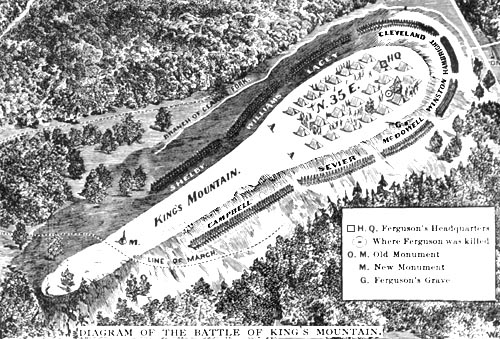
He won that nickname at the age of 29 on the wet, steep hillsides of King’s Mountain. There, British Col. Patrick Ferguson waited for his approach. Along with Shelby came over a thousand Patriot warriors from Over the Mountain.  


Ferguson had a poor view of Shelby and the Over the Mountain men.  In his mind they had run from him at Wofford's Iron Works (Battle of Cedar Springs) in Spartanburg. The band of rugged Patriots had taunted the King's men from a hill and led them on a merry chase that left Ferguson frustrated.


The British leader also considered them a group of thieves who had settled in the lands off limits to British subjects.  

Having just missed Shelby and the others at the battle of Musgrove Mills on August 19th, 1780, he set out in pursuit towards Gilbert Town, near present day Rutherfordton, NC.  


Ferguson was seeking a fight and
 grew more confident as the Loyalist poured into his camp for safety.

His letter to Cornwallis revealed a positive attitude towards the number of loyalists coming into camp. Ferguson then made ready to gather more supplies and search for cattle to feed his growing army. (2)


But Ferguson was unaware that he was being tricked and was in a chess match with his betters. Shelby, along with his fellow leaders at Musgrove Mill, convinced the inhabitants of the mountain regions around Gilbert Town to take shelter under the King's protection. By doing this they would be able to save their cattle that they had hid away in the mountain passes for the Patriot cause.


Ferguson's soldiers sallied forth out of camp in search of beef among the Patriot farmers.  Finding a herd they began their work of preparing the meat for the meals.  As they were well into their work, Ferguson was informed that they had been decimating the herds of three of his own loyalist men.  Ferguson had been duped by Colonel Shelby and British influence in the area suffered even more.


About that same time, Colonel Ferguson paroled an Over the Mountain prisoner in his entourage and sent him with a message to Isaac Shelby in particular.  Samuel Philips found Shelby and relayed the message, "If they did not desist from their opposition to the British arms, he would march his army over the mountains, hang their leaders, and lay their country waste with fire and sword."  Philips, ever the soldier, then set about giving particulars on the makeup of Ferguson's army to Colonel Shelby.


Shelby and the leaders at Musgrove Mills had foreseen that Ferguson had plans for their mountain homeland even before he had left the South State.  They had agreed to begin recruiting an army to confront Ferguson as soon as the opportunity presented itself. Now was the time. 


Shelby would take the lead and find John Sevier and other leaders and start towards the invading army.  Dispatches and messengers were sent throughout the mountains.


They came in droves.  Hundreds from different counties and valleys converged on the meeting places in Morganton and Gilbert Town.  They came, on horseback and on foot, with a purpose to confront the threats of Colonel Ferguson and the British realm.  These were wild hunters of hearty stock who understood Freedom and self government.  They were armed with rifles and were expert marksmen. They came over the snow covered mountains and down through the valleys.  They forded mountain streams and rivers while keeping their powder dry.  They came on knowing that they might not come back.  They came in droves. With Colonel Shelby....They came for a Reckoning!


Ferguson, at first, did not comprehend his peril. He allowed his personal biases to not see his enemy for what it was...a battle-hardened foe led by Colonel Shelby (and others).  He either couldn't or wouldn't see that Shelby was neither awed by British might nor one to lose a fight.  Colonel Ferguson lingered, hoping to cut off Georgia Patriot Col. Elijah Clarke coming from Augusta, Ga. He would wind his way back down the mountain passes, stall for a little more time for Clarke to appear.  The Redcoats would then feint southwest towards Ninety Six and ultimately head east to draw on support from Lord Cornwallis. Clarke never showed, but Shelby and company came on with a purpose and closed the distance.


Cornwallis was easily within reach at Charlotte, NC had Ferguson simply been prudent. But Ferguson chose the small mountain spur of King's Mountain to make his stand.  He had trained and bragged about his group of Loyalists in his camp and now that confidence would be tested. Ferguson trusted in his position and his loyal troops numbering close to 1000 men at arms.  He would even boast about his chosen defensive position and swore it could not be taken.(3)  


After being on the march for 2 weeks, Colonel Shelby made sure the British threats were answered. On October 7, 1780 the Mountain men surrounded the summit and were urged to do their duty; and if they did, the day would be won.

Image result for isaac shelby

Drawing on his experience fighting the Shawnee, Shelby would tell his men at King’s Mountain, “Be your own officer...If in the woods, shelter yourselves, and give them Indian play; advance from tree to tree, pressing the enemy and killing and disabling all you can.”(4) 

The battle raged for just over an hour and Ferguson was left dead on the field.  His words to Colonel Shelby had inflamed the Patriot zeal and left the British leader cold and prostrate.  Shelby, by contrast, stood erect, unscathed and was every bit in control of his men and his duty.


After the battle of Kings Mountain and before the march off the precipice, the prisoners were ordered to line up and shoulder rifles that were stacked. An elderly loyalist of King George feigned old age as a reason for not picking his up.  Shelby slapped him with the flat edge of his sword and said, that he(Shelby) had brought one so the tory could take one away.  The tory jumped to, grabbed a rifle and got into line.(5)

In 1781 Shelby would fight under Francis Marion and add more wins to his war record.

He would later become the first and fifth governor of Kentucky and serve in the War of 1812.(6)

Fearless, determined and able, Colonel Shelby was one of the many heroes of King's Mountain and the Revolution in the South.  He was followed and feared in the cause of Liberty all throughout his life and the Country owes him great respect and gratitude.

Many towns and counties were named in his honor, including the North Carolina city just north of Kings Mountain.  Freedom Reigns!

(3) Before They Were HEroes at King's Mountain, Randell Jones
(4) The Battles of Kings Mountain and Cowpens: The American Revolution in the Southern Backcountry, Melissa A. Walker
(5) History of the Upper Country of SC, Logan