Showing posts with label Elijah Clarke. Show all posts

Monday, August 13, 2018

Musgrove Mill


Ferguson was frustrated.
 
At the Battle of Wofford’s Iron Works (Spartanburg) on August 8, 1780 American Col. Isaac Shelby and his frontiersmen played cat and mouse with Cornwallis’ man and eluded his British force with taunts and jeers on a hillside out of musket range.(1)  This came just a little over a week after Loyalists surrendered to Col. Shelby’s Indian fighters at Thicketty Fort without firing a shot.
 
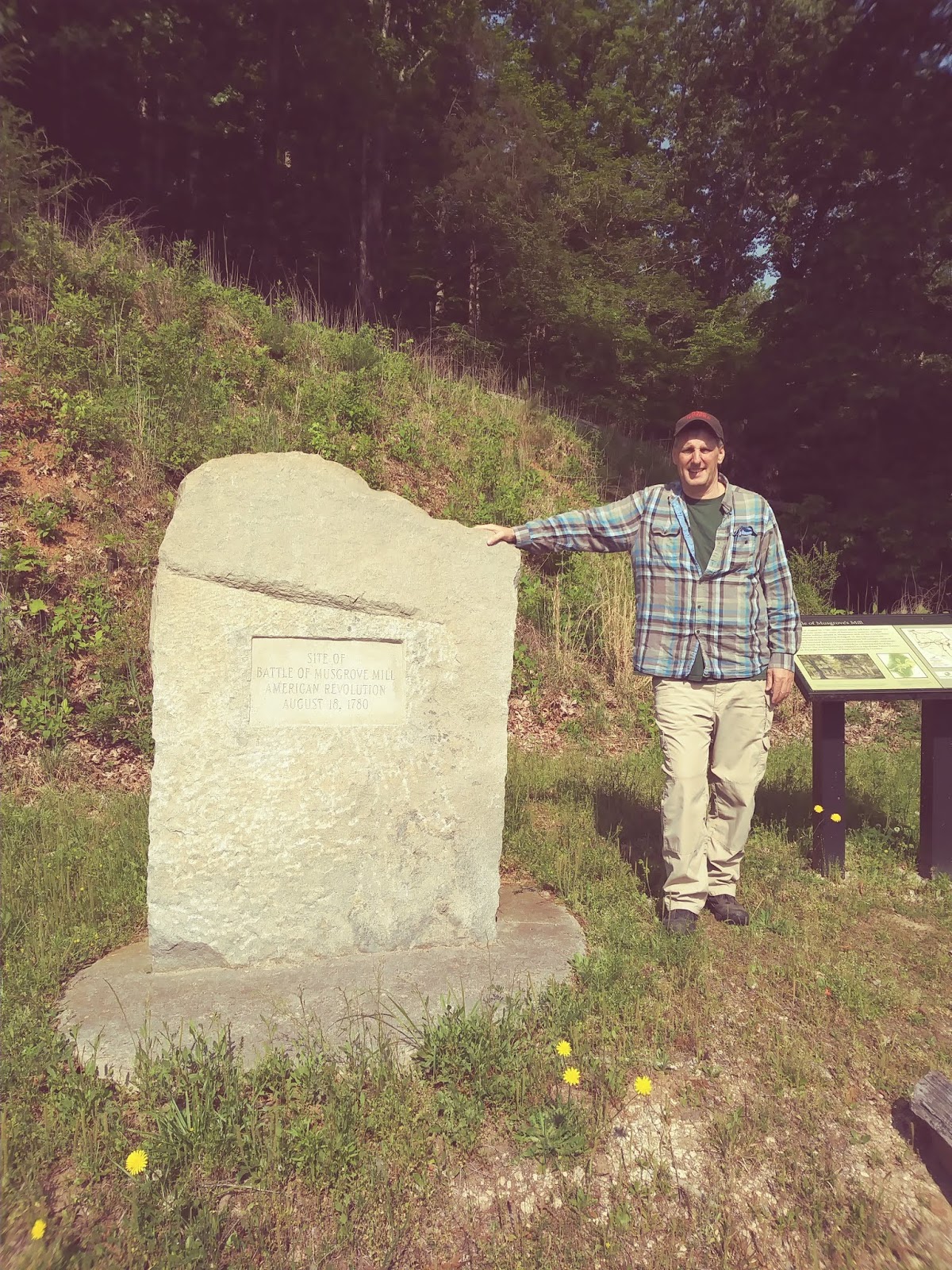
That frustration would mount as on August 19th the Patriot bands of warriors under Shelby, SC militia Col. James Williams and Patriot Col. Elijah Clarke slipped in behind Ferguson's lines during a night-time ride and engaged Loyalists at Musgrove Mill (present-day southern, Spartanburg County) that morning.  The American Revolutionaries numbered about 300 men at arms. 

After halting in an open Indian field about a mile from the Ford of the Enoree River, scouts were sent out to gain intelligence on the enemy just before dawn.  Shots were fired and the scouts, though some wounded, made it back to camp and reported enemy numbers to be over twice the anticipated force of 200.

Sometime during the night reinforcements, intended for Col. Ferguson, had arrived at the British camp and were anticipating joining up with the left wing of the Red Coat army on their march northward.  Among these in camp at Musgrove Mill were two hundred Provincials from New York under the command of Colonel Alexander Innes.  

Shelby was outnumbered, his horses were spent, and his enemy would be reinforced by Ferguson soon. 

Shelby needed to draw again from his tactical skills forged in the furnace of Indian wars.  He chose to fight. He ordered his men to build breastworks of fallen logs and brush across the expanse of the open field in a rough semi-circle.  His plan to use cover and concealment during the battle would equal the playing field to the benefit of his men, as the British would be attacking a more fortified position without cover of their own.  Shelby and his contingent of frontiersmen under the bold Josiah Culbertson were on the right. Williams and his South Carolina militia were in the center. Clarke’s courageous Georgia troops were on the left.  Reserve troops were within earshot and hidden nearby; while the horses were staged in the rear.

The trap was set.

Now for the bait.
Looking up towards the British encampment
British Colonel Innes urged his reluctant peers in the war council to make haste and give fight to the rebel band who he had little regard for.  Some in the council wished to finish their breakfast and wait for Ferguson, but Innes was insistent.  As they made ready, Patriot Captain Inman and 25 men sallied in towards the King's camp and fired at the British from across the river, enticing them to give chase.  Innes did not hesitate nor disappoint.  

Innes’s whole force, save one hundred in reserve at the house, followed down and then up the hill on the heels of Inman and his party of Whigs; whom they believed represented the whole of the rebel band.  Unknown to them, Josiah Culbertson's party were concealed on their flank as they moved up the hill.(2)  The loyalists, answering the bugle calls, drums and shouts of their leaders, formed up and advanced to within 70 yards of the breastworks, bayonets at the ready.
Looking up towards the Patriot breastworks
Suddenly a deadly accurate fire was unleashed at the British just when they had let out a “Huzzah for King George!”  The attacking British staggered but for a moment.  They checked their lines and resumed their march.  Disciplined and steady, they came on with bayonet and determination.  The Patriot riflemen were much slower in their reloads than the British soldiers and their muskets. To make matters worse, the British cold steel was pressing in.  These anxious moments were observed by Shelby and Clarke and orders were given with haste.

The forty men in reserve were called up and filled the ranks of the riflemen who were being pressed hard.  At this critical juncture, Colonel Innes was killed by one of the Over the Mountain men and in the ensuing moments the tide changed for the advancing British.  

The frontiersmen let out an Indian war cry and rushed into the fray of smoke and powder and into close quarter combat.  The screams, the gun fire and the battle yell of charging wild warriors were all mixed with the smoke that made it impossible to see beyond 20 yards.  

The loyalist militia in front of Clarke gave way and began to fall back. Soon it was a full-blown retreat as the British ran back down the road from which they had come.  The dead and wounded lay scattered along the route as the Patriots were in hot pursuit and continuing to engage their enemy, even into the river ford.

One of the Tories, still bold despite the retreat, decided to drop his trousers and show his mooned cheeks to his pursuers as he made his way up the opposite hill.  He was paid in full with a bullet to his pasty white backside and carried off in shame and discomfort.(3)

In just about an hour of heavy fighting the smoke clears, and Shelby is the victor.  He has now beat the enemy three times in the field under less than favorable conditions, all within 3 weeks time. 

The victory is short lived as an express rider comes in from Colonel Davie at the Waxhaws informing the victors of the defeat of Gates at Camden, SC. 

Davie, who was riding to help in the battle at Camden, had observed Gates fleeing northward. Davie adjusted his own orders and turned back. He then prudently sent out messages to leaders still in the field, to include Thomas Sumter and Shelby's command structure.  Sumter suffers defeat at Fishing Creek above Great Falls, SC and flees to Charlotte.  Shelby and his army dispersed and seemingly vaporize into the mountains with their prisoners above present day Rutherford, NC.  The reality is Shelby would not let them rest till they were safely in the mountain passes and many of his warriors were starving and fatigued when they got home.
 
As Ferguson arrives too late to assist in the battle it is evident that Shelby has eluded the British Colonel once again.  His subsequent pursuit into the North State is met with equal results.(3,4)

But South Carolina is without a formal army to oppose the British and Cornwallis has his sights set on Charlotte and beyond.  Cornwallis sends Ferguson into the mountains where he imprudently threatens to lay waste to Scots-Irish Patriot homes and hang their leaders.  

General Washington sends Nathaniel Greene and Daniel Morgan south to raise an army and continue the fight.  

The Over the Mountain men begin raising their own army and are helped in recruitment by the bold and aggressive talk of Ferguson.

A reckoning is coming! 
Freedom Reigns!


(1)King’s Mountain and It’s Heroes: History of the Battle of King’s Mountain, October 7th, 1780, and the Events Which Led to It, Draper, Allaire
(2)http://sc_tories.tripod.com/battle_of_musgrove_mill.htm
(3)Before They Were Heroes at King’s Mountain, Randell Jones
(4)Parker’s Guide to the Revolutionary War in South Carolina, John C. Parker

Thursday, July 26, 2018

Thicketty Fort


Captain Johnson had a hard time wrestling Tory Captain Patrick Moore into submission.  Moore and his Loyalist sympathizers had been on the run from their defeat at Ramsour’s Mill near Lincolnton, NC for 12 days and were not too willing to fall into the hands of these Liberty Men. At six foot seven inches tall(1), Moore was giving his fair share and was able to open up multiple cuts on Johnson’s head and thumb. Despite it all, Captain Johnson was hauling him in towards the rest of the Patriot contingent.  The spilled blood; however, got into the Johnson’s powder and he misfired as reinforcements arrived for the Loyalist leader.  While Johnson retreats through the bushes, Captain Moore escapes and is able to make it home on Thicketty Creek, outside of Gaffney, SC. (2)

Captain Moore had reinforced a fort there and commanded a body of loyalist men with good stores of weaponry.  Undaunted by his near fatal encounter with Johnson, Moore’s command had become a staging point for the Tories to launch raiding parties on the Patriot homes and farms in the back country. So much so that it raised the ire of not only General Sumter in South Carolina, but also Col. McDowell from NC.  Both were in the area of conflict attempting to win and subdue the land for the cause. Independently they had both sent out warriors to attack Fort Thicketty.  Elijah Clarke, Isaac Shelby, Andrew Hampton and Charles Robertson met and combined their forces to put and end to the threat. 

The fort itself was surrounded by abatis that made it difficult to approach without impaling oneself on the pointed timbers.  Similar structures were used at the star fort at Ninety-Six and other conflict areas. Fort Thicketty sat upon a rise above the creek and had loopholes in the walls from which to fire at the enemy from cover. To overcome even a crude abatis takes coordination and firepower under extreme exposure.  To make offensive operations against the fort even worse, the fort had only one opening by which to enter the enclosure.  Moore’s men were more than confident that they could repel the forces that approached their bastion in the back country.(3)

Colonel Shelby and his men of daring were not ones to shrink from a fight.  Shelby arrived at the fort on July 26, 1780 and sent word to Moore to surrender at once.  Moore refused, and he and his Tory militia steeled their nerves for the fight. Col. Shelby then arrayed all 600 of his men into firing positions in a way that was meant to intimidate.  All along the wood line surrounding the fort, Moore and his militia observed the Liberty Men step out with their rifles and storied hunting shirts.  Certainly, they had the set jaws and determination of men used to conflict on the Indian frontier and mimicked their leader as they put on a show of force.  Shelby, again, called out for a parley with Moore.  Moore assured his men, as he left out for the discussion of terms, that he would not be surrendering and that he intended to fight.

Perhaps it was his recent brush with death at the hands of some of these same men outside of Lincolnton.  Or perhaps it was his subsequent near-death experience near the Wofford’s Iron works at the hands of Captain Johnson not 24 days removed.  Or perhaps it was a combination of so many seasoned fighting men standing before Moore’s little fort of friends and neighbors. Whatever the single or combination of reasons, Captain Moore agreed to surrender the fort if his men were spared and paroled.  To the dismay of his men, the Loyalist Captain walked back to the fort under Patriot escort and turned the fort over without firing a shot in defense.
 
Col. Shelby’s ruse worked, and the Sons of Liberty were fortunate, indeed.  Among the stores of weaponry were found ready muskets loaded with “buck and ball” at the gun ports of the fort.  Had Captain Moore fought it out, Colonel Shelby may have been hard pressed to win without cannon.  At the very least he would have paid dearly with the lives of his men to win the day.   Captain Moore’s capitulation without a fight saved many lives that day on both sides, but he held the title of coward in the eyes of his superiors in General Cornwallis’ camp.(2, Ibid)

The month was a sore one for the British in the upstate.  Having taken Charleston, the British had set their sights on the upcountry, but suffered some setbacks.  Lt. Col. Turnbull wrote Cornwallis about his Ramsour’s Mill investigation and chastised the Loyalist timing at Lincolnton.  He also warned of the Scots Irish,  "As for the majority Scots-Irish inhabitants of the Catawba River Valley," Turnbull wrote: "I wish I could say something in their favor. I believe them to be the worst of creation - and nothing will bring them to reason but severity.”(4)  

But Cornwallis did not understand what the threat in this quarter really was. He was on the move and was concentrated on the Continental army.  He had a destiny with Gates at Camden.  His response for the left flank of his army was to send Major Patrick Ferguson.  He would write later, after the blinders were off, "A numerous and unexpected enemy came from the mountains.  As they had good horses, their movements were rapid."(3,ibid)
 
A reckoning was coming!  And for the next 72 days Liberty was in question.  Freedom Reigns!


(1)      Kings Mountain and It’s Heroes:  The Battle of King’s Mountain, October 7Th, 1780, and the Events Which Led to It, Lyman Copeland Draper, Anthony Allaire
(2)      Parker’s Guide to the Revolutionary War in South Carolina, John C. Parker Jr.
(3)      Before they were Heroes at King’s Mountain, Randell Jones
(4)      Neighborhood in Constant Alarm: The Battle of Ramsour’s Mill and Partisan Divisions in the Carolina Backcountry Communities During the American Revolution, Austin William Smith