Showing posts with label Over the Mountain men. Show all posts

Thursday, October 11, 2018

Mr. and Mrs. William Moore


William Moore was a bold and fearless fighter during the Revolutionary war.  Taking up his rifle and horse, he would leave his wife at home to confront the British before they came to his doorstep.

 On making the long journey from Abingdon, Virginia with Colonel Campbell, he proved himself in the eyes of his leader.  He was selected at Cowpens, SC to be a part of the flying column.  This 900-man force was culled from the bigger army that had come and camped at Cowpens in the hunt for Major Ferguson.  Moore headed off with this fast-moving contingent that ultimately surrounded the British at Kings Mountain.

The warriors that fought with Campbell were described by an injured Tory, Drury Mathis, as darting about the mountain during the battle “like enraged lions.” Drury went on to say, “they were the most powerful looking men he had ever beheld; not over-burdened with fat, but tall, raw boned, and sinewy, with long matted hair…” 

William Moore was among these men of the mountains.  During the battle he was wounded badly in the leg and it was amputated in the field to save his life.  Moving back over the mountains on a 10-day journey was not something he could do.  Potential for infection was too high and a lack of medical supplies a reality.  He was left in the care of nearby good Samaritans while his compatriots made the long journey home.

Once at home, they gladly recounted their tails of victory to all who would listen.  An air of joy permeated the community as the warriors returned.

Among the listeners was Mrs. Moore who inquired about her husband’s fate.  

Hearing that her husband had been wounded and was still in the area where British General Cornwallis was, she saddled her own horse and immediately set out in search of her loved one.

Back across the November mountains and down through North Carolina she rode with bold determination to find her loved one. She camped beneath the stars and elements.  She forded rivers and streams.  Her journey was as like and long as the army that preceded her, but without the company of thousands of men.

Bold and fearless she rode on with determined spirit, until at last she found him.

Their story certainly had the makings of a ballad.  He, leaving home to protect her and she, leaving home to find and care for him.  They loved and lived to be a ripe old age.  Their story was a source of pride and a touchstone of patriotic fervor for the family generations afterward. (1)

Freedom Reigns!


(1)    King’s Mountain and Its Heroes: History of King’s Mountain, October7th, 1780, and the Events Which Led to It, Lyman Draper, Anthony Allaire

Thursday, September 20, 2018

Signal Fires


Signal Beacons of Gandor used in NC mountains during the revolution?


Local folklore in and around Wilkes and Caldwell Counties in NC reveal the story of Martin Gambill. His 100-mile journey to warn the Patriots of the British invasion into the mountains is the stuff of Legends.  The story goes that the watch fires that had been placed upon the top of the mountains as an early warning system did not reach into the Watauga area where a good portion of the Liberty men resided.  Thus he volunteered to ride with the news. (1)(2)

Historical record of watch fires in the North Carolina theater of operations is spotty at best.  It will take longer to research than this author has available as of this writing.  We find evidence of similar watch fires used in the northern theaters of operation as Washington ordered them placed in the Hudson Hills in New York and the Watchung Mountains of New Jersey.  The latter of these was memorialized in a Baron Dekalb report.
   
In the Watchung Mountains these fires of freedom had three main purposes: “to call out the militia, to indicate the approach direction of the British and to direct the subsequent movements of the militia. There were also instructions on their construction and placements.  Twenty-three signal pyres were constructed in the New Jersey mountainsides and manned by close to two dozen soldiers each. (3)

Later, DeKalb fought and died at the Battle of Camden, SC in the Southern Theater of Operations months before Kings Mountain. General Gates, his commanding officer at Camden, was still around Hillsborough, NC and recognized by the Patriots there as having Continental authority.  It is not a hard leap to suspect that there is some truth to the legend of these watch-fires, even if they did not look quite as stately as the fictitious Gandor beacons.

Though the record is thin on these watch fires being a part of the Southern Continental strategy, it certainly causes this author to want to dig deeper. It is not hard to fathom signal fires on the top of Table Rock, Grandmother and Grandfather Mountains and the smaller precipices further down Highway 64, or even into the Pisgah National Forest. It harkens back to the warning fires of the Peel towers in Scottish castles. (4) 


And these Patriots were most definitely of the Scots Irish heritage.


Freedom Reigns!


Friday, September 14, 2018

The Davenports


“If you want your horses fed, feed them yourself," replied ten-year-old William Davenport to Tory leader John McFall in September of 1780. Channeling his father's courage he would become a leader in his own right as he grew older.  The Davenport College for Women in Lenoir, NC was formed through his philanthropy.

John McFall served in Major Ferguson’s 1000-man army in the mountains and helped to subdue the rebel element there.  All through the mountain back country Ferguson’s men would search for the patriot militiamen and turn their wrath on rebel families when the men folk were not at home.  The women and children were turned out and the property was destroyed.  With nowhere to go, these refugees of liberty were found wandering and living off the land with bare clothes upon their backs. 

A poor and emotional sight that would help induce the back-country inhabitants to rise up against the Brits.

McFall and his men had rushed the Davenport home near Wilson Creek at the John’s River in search of Captain Martin Davenport of the Burke County militia.  The good Captain was off serving in the field so McFall forced Mrs. Davenport to feed his band of Loyalists.  When young Davenport boldly refused McFall’s demands and took up his father’s independent spirit, McFall whipped him. 

McFall would pay eternally for his misstep and swing from the hangman’s noose during the time of reckoning a few weeks later.(1)

A few years after the war the Davenport’s moved further up into the mountains off the Toe River.  Captain Martin Davenport sought freedom and independence in the solitude of the mountains just west of the Linville caverns.  He would become a hunting guide, an entertainer to foreign guests, protector of the poor and a coroner.(2)
 
The young William Davenport would become a prominent member of the community around Lenoir as well.  He was a magistrate, State representative and State Senator.  The Davenport Women’s College was his namesake and the buildings upon that hill still house an elementary school as well as the Caldwell Heritage Museum.(3)  Freedom Reigns!


(1) King’s Mountain and It’s Heroes: History of the Battle of King’s Mountain, October 7th, 1780, and the Events Which Led to It, Lyman C. Draper, Anthony Allaire

Wednesday, September 12, 2018

the McDowells


In September of 1780 British Major Patrick Ferguson raised his army of over 1000 men and headed up into the North Carolina Mountains. Going through present day, Chesney, SC and onto Rutherfordton, NC., his army would live off the land as they worked their way from community to hamlet. On the general route laid out by the old Hwy 64 in NC., they rousted leaders and families to subdue the rebellion.

Ferguson had missed Colonel Isaac Shelby who had already made good his retreat over the mountains. But the left-wing commander of Cornwallis’ army had caught the scent of NC militia Colonel Charles McDowell and his force of about 160 men. McDowell was headed for the Watauga river valley in Tennessee, which is northwest of the present-day Beech Mountain snow resort of North Carolina.

Charles and his band of warriors had gone into South Carolina to stall Cornwallis and lend aid where they could.  McDowell was a prominent man in his community and he and his wife manufactured gunpowder in the Quaker Meadows of Morganton, NC.  McDowell had been appointed as a Colonel in the Burke County, NC militia and his brother, Joseph (a Major), served under him in all their military engagements. 

They had hoped to battle the King’s men in South Carolina and keep them away from their homes.  Colonel McDowell had sent out forces that won at Fort Thicketty and Musgrove Mill and the McDowells had done their duty and given aid and sword wherever they could.  Now they were on the retreat. (1)

As brothers they were a force to be reckoned with.  Where one, Charles, had the confidence of the local leaders; the other, Joseph, was a true fighter who inspired the men from Burke County and beyond. 

When Ferguson marched up old Hwy 64, the McDowells were ready for him at the headwaters of the Cane Creek.

The Patriots, though outnumbered, had laid an ambush up on the high ground and challenged the Lobster backs, led by their British Major.  On September 12, 1780 Patriot shots were fired from concealed positions and the Loyalists recoiled from the initial surprise, but they rallied.  With rifle and bayonet, Ferguson’s men began to make headway toward the Patriot lines up the hill. 
 Joseph McDowell

Joseph McDowell was heard swearing and yelling for his men to stand and die with him if need be, and that he would never yield!(2)  Rifle fire would mix with yells, screams and smoke in that shadow of the South Mountains. The Patriots fought for time and freedom to make good their escape.

The Brits only left the field after they claimed victory, but they came up short in the fray. Bones from the fight were still found four decades later, strewn across the battlefield. These remnants of the dead seemed to belie the viewpoint of victory that Ferguson’s men professed.   In the end, both sides lost men. 

But the McDowells were able to make good their escape. The Brits made their way back to Gilbert town with an unknown number of dead and wounded. Among the wounded was one Captain James Dunlap, a veteran of the Queen’s Rangers and leader of a troop of Loyalist mounted riflemen. Out of action for some time and convalescing from a serious wound to the leg, he would not see action again with Major Ferguson.

Dunlap was sheltered in a Loyalist home and could not move with the army.  He would later be shot by the Patriots seeking revenge for the death of Noah Hampton in South Carolina. His attackers failed to make sure he was dead, though, and he dodged their attempt to end his life. Rumor, lies and a false grave were utilized to stay one step ahead of his pursuers.

Perhaps the most telling result of this “check” by McDowell on Ferguson was what happened in the next few weeks.  Word got out to the countryside of the intrusion of the King’s forces into the mountain regions. In a short time, Ferguson begins to hear that an army of mountaineers are coming like a fog out of the high valleys across the Blue Ridge.  Coming for him!  

A Reckoning was coming!  Freedom Reigns!

(2)King’s Mountain and Its Heroes: A History of the Battle of King’s Mountain, October 7th, 1780, and the Events Which Led to It., Lyman C. Draper, Anthony Allaire


Monday, August 13, 2018

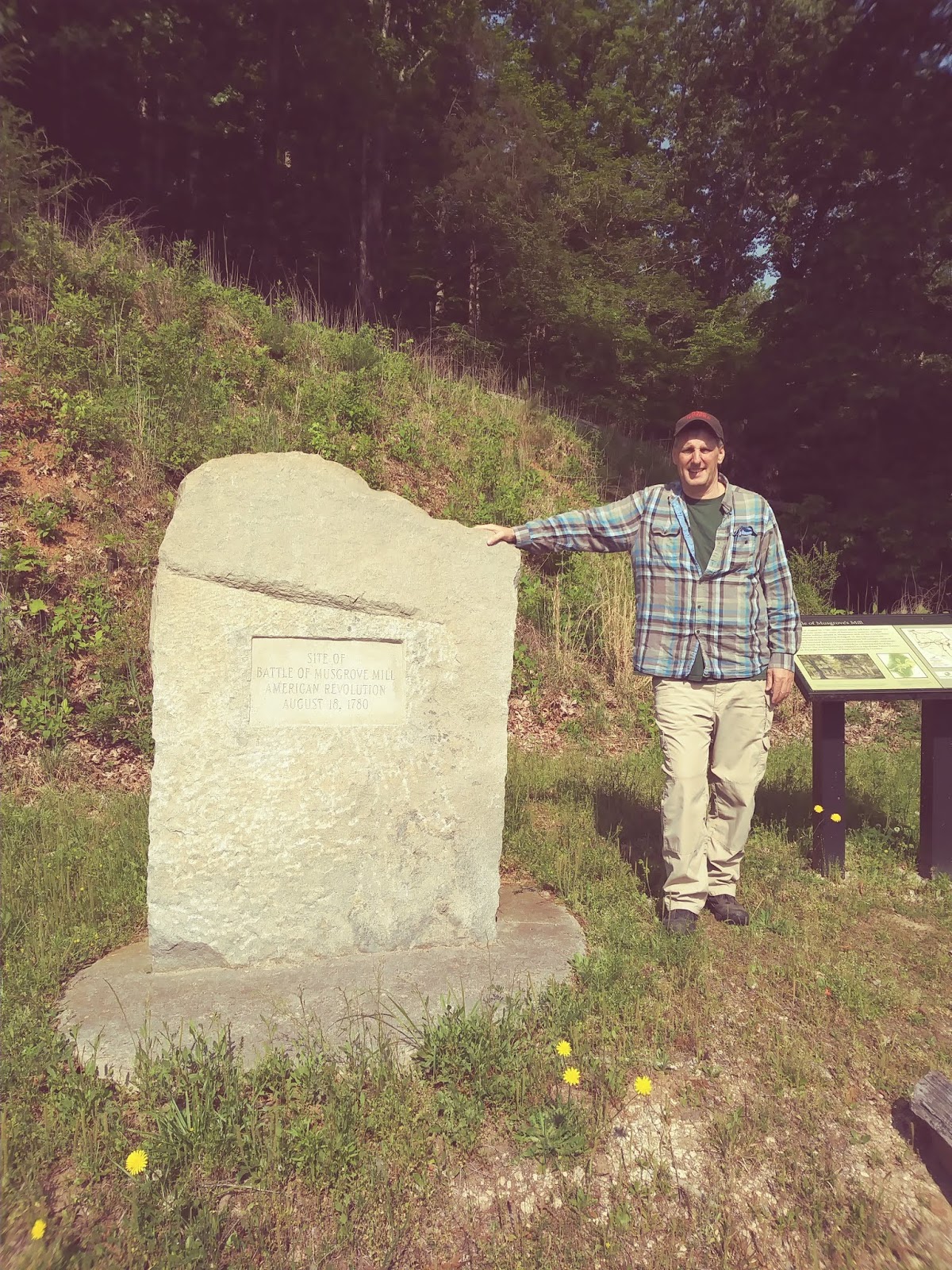
Musgrove Mill


Ferguson was frustrated.
 
At the Battle of Wofford’s Iron Works (Spartanburg) on August 8, 1780 American Col. Isaac Shelby and his frontiersmen played cat and mouse with Cornwallis’ man and eluded his British force with taunts and jeers on a hillside out of musket range.(1)  This came just a little over a week after Loyalists surrendered to Col. Shelby’s Indian fighters at Thicketty Fort without firing a shot.
 
That frustration would mount as on August 19th the Patriot bands of warriors under Shelby, SC militia Col. James Williams and Patriot Col. Elijah Clarke slipped in behind Ferguson's lines during a night-time ride and engaged Loyalists at Musgrove Mill (present-day southern, Spartanburg County) that morning.  The American Revolutionaries numbered about 300 men at arms. 

After halting in an open Indian field about a mile from the Ford of the Enoree River, scouts were sent out to gain intelligence on the enemy just before dawn.  Shots were fired and the scouts, though some wounded, made it back to camp and reported enemy numbers to be over twice the anticipated force of 200.

Sometime during the night reinforcements, intended for Col. Ferguson, had arrived at the British camp and were anticipating joining up with the left wing of the Red Coat army on their march northward.  Among these in camp at Musgrove Mill were two hundred Provincials from New York under the command of Colonel Alexander Innes.  

Shelby was outnumbered, his horses were spent, and his enemy would be reinforced by Ferguson soon. 

Shelby needed to draw again from his tactical skills forged in the furnace of Indian wars.  He chose to fight. He ordered his men to build breastworks of fallen logs and brush across the expanse of the open field in a rough semi-circle.  His plan to use cover and concealment during the battle would equal the playing field to the benefit of his men, as the British would be attacking a more fortified position without cover of their own.  Shelby and his contingent of frontiersmen under the bold Josiah Culbertson were on the right. Williams and his South Carolina militia were in the center. Clarke’s courageous Georgia troops were on the left.  Reserve troops were within earshot and hidden nearby; while the horses were staged in the rear.

The trap was set.

Now for the bait.
Looking up towards the British encampment
British Colonel Innes urged his reluctant peers in the war council to make haste and give fight to the rebel band who he had little regard for.  Some in the council wished to finish their breakfast and wait for Ferguson, but Innes was insistent.  As they made ready, Patriot Captain Inman and 25 men sallied in towards the King's camp and fired at the British from across the river, enticing them to give chase.  Innes did not hesitate nor disappoint.  

Innes’s whole force, save one hundred in reserve at the house, followed down and then up the hill on the heels of Inman and his party of Whigs; whom they believed represented the whole of the rebel band.  Unknown to them, Josiah Culbertson's party were concealed on their flank as they moved up the hill.(2)  The loyalists, answering the bugle calls, drums and shouts of their leaders, formed up and advanced to within 70 yards of the breastworks, bayonets at the ready.
Looking up towards the Patriot breastworks
Suddenly a deadly accurate fire was unleashed at the British just when they had let out a “Huzzah for King George!”  The attacking British staggered but for a moment.  They checked their lines and resumed their march.  Disciplined and steady, they came on with bayonet and determination.  The Patriot riflemen were much slower in their reloads than the British soldiers and their muskets. To make matters worse, the British cold steel was pressing in.  These anxious moments were observed by Shelby and Clarke and orders were given with haste.

The forty men in reserve were called up and filled the ranks of the riflemen who were being pressed hard.  At this critical juncture, Colonel Innes was killed by one of the Over the Mountain men and in the ensuing moments the tide changed for the advancing British.  

The frontiersmen let out an Indian war cry and rushed into the fray of smoke and powder and into close quarter combat.  The screams, the gun fire and the battle yell of charging wild warriors were all mixed with the smoke that made it impossible to see beyond 20 yards.  

The loyalist militia in front of Clarke gave way and began to fall back. Soon it was a full-blown retreat as the British ran back down the road from which they had come.  The dead and wounded lay scattered along the route as the Patriots were in hot pursuit and continuing to engage their enemy, even into the river ford.

One of the Tories, still bold despite the retreat, decided to drop his trousers and show his mooned cheeks to his pursuers as he made his way up the opposite hill.  He was paid in full with a bullet to his pasty white backside and carried off in shame and discomfort.(3)

In just about an hour of heavy fighting the smoke clears, and Shelby is the victor.  He has now beat the enemy three times in the field under less than favorable conditions, all within 3 weeks time. 

The victory is short lived as an express rider comes in from Colonel Davie at the Waxhaws informing the victors of the defeat of Gates at Camden, SC. 

Davie, who was riding to help in the battle at Camden, had observed Gates fleeing northward. Davie adjusted his own orders and turned back. He then prudently sent out messages to leaders still in the field, to include Thomas Sumter and Shelby's command structure.  Sumter suffers defeat at Fishing Creek above Great Falls, SC and flees to Charlotte.  Shelby and his army dispersed and seemingly vaporize into the mountains with their prisoners above present day Rutherford, NC.  The reality is Shelby would not let them rest till they were safely in the mountain passes and many of his warriors were starving and fatigued when they got home.
 
As Ferguson arrives too late to assist in the battle it is evident that Shelby has eluded the British Colonel once again.  His subsequent pursuit into the North State is met with equal results.(3,4)

But South Carolina is without a formal army to oppose the British and Cornwallis has his sights set on Charlotte and beyond.  Cornwallis sends Ferguson into the mountains where he imprudently threatens to lay waste to Scots-Irish Patriot homes and hang their leaders.  

General Washington sends Nathaniel Greene and Daniel Morgan south to raise an army and continue the fight.  

The Over the Mountain men begin raising their own army and are helped in recruitment by the bold and aggressive talk of Ferguson.

A reckoning is coming! 

Freedom Reigns!


(1)King’s Mountain and It’s Heroes: History of the Battle of King’s Mountain, October 7th, 1780, and the Events Which Led to It, Draper, Allaire
(2)http://sc_tories.tripod.com/battle_of_musgrove_mill.htm
(3)Before They Were Heroes at King’s Mountain, Randell Jones
(4)Parker’s Guide to the Revolutionary War in South Carolina, John C. Parker

Thursday, July 26, 2018

Thicketty Fort


Captain Johnson had a hard time wrestling Tory Captain Patrick Moore into submission.  Moore and his Loyalist sympathizers had been on the run from their defeat at Ramsour’s Mill near Lincolnton, NC for 12 days and were not too willing to fall into the hands of these Liberty Men. At six foot seven inches tall(1), Moore was giving his fair share and was able to open up multiple cuts on Johnson’s head and thumb. Despite it all, Captain Johnson was hauling him in towards the rest of the Patriot contingent.  The spilled blood; however, got into the Johnson’s powder and he misfired as reinforcements arrived for the Loyalist leader.  While Johnson retreats through the bushes, Captain Moore escapes and is able to make it home on Thicketty Creek, outside of Gaffney, SC. (2)

Captain Moore had reinforced a fort there and commanded a body of loyalist men with good stores of weaponry.  Undaunted by his near fatal encounter with Johnson, Moore’s command had become a staging point for the Tories to launch raiding parties on the Patriot homes and farms in the back country. So much so that it raised the ire of not only General Sumter in South Carolina, but also Col. McDowell from NC.  Both were in the area of conflict attempting to win and subdue the land for the cause. Independently they had both sent out warriors to attack Fort Thicketty.  Elijah Clarke, Isaac Shelby, Andrew Hampton and Charles Robertson met and combined their forces to put and end to the threat. 

The fort itself was surrounded by abatis that made it difficult to approach without impaling oneself on the pointed timbers.  Similar structures were used at the star fort at Ninety-Six and other conflict areas. Fort Thicketty sat upon a rise above the creek and had loopholes in the walls from which to fire at the enemy from cover. To overcome even a crude abatis takes coordination and firepower under extreme exposure.  To make offensive operations against the fort even worse, the fort had only one opening by which to enter the enclosure.  Moore’s men were more than confident that they could repel the forces that approached their bastion in the back country.(3)

Colonel Shelby and his men of daring were not ones to shrink from a fight.  Shelby arrived at the fort on July 26, 1780 and sent word to Moore to surrender at once.  Moore refused, and he and his Tory militia steeled their nerves for the fight. Col. Shelby then arrayed all 600 of his men into firing positions in a way that was meant to intimidate.  All along the wood line surrounding the fort, Moore and his militia observed the Liberty Men step out with their rifles and storied hunting shirts.  Certainly, they had the set jaws and determination of men used to conflict on the Indian frontier and mimicked their leader as they put on a show of force.  Shelby, again, called out for a parley with Moore.  Moore assured his men, as he left out for the discussion of terms, that he would not be surrendering and that he intended to fight.

Perhaps it was his recent brush with death at the hands of some of these same men outside of Lincolnton.  Or perhaps it was his subsequent near-death experience near the Wofford’s Iron works at the hands of Captain Johnson not 24 days removed.  Or perhaps it was a combination of so many seasoned fighting men standing before Moore’s little fort of friends and neighbors. Whatever the single or combination of reasons, Captain Moore agreed to surrender the fort if his men were spared and paroled.  To the dismay of his men, the Loyalist Captain walked back to the fort under Patriot escort and turned the fort over without firing a shot in defense.
 
Col. Shelby’s ruse worked, and the Sons of Liberty were fortunate, indeed.  Among the stores of weaponry were found ready muskets loaded with “buck and ball” at the gun ports of the fort.  Had Captain Moore fought it out, Colonel Shelby may have been hard pressed to win without cannon.  At the very least he would have paid dearly with the lives of his men to win the day.   Captain Moore’s capitulation without a fight saved many lives that day on both sides, but he held the title of coward in the eyes of his superiors in General Cornwallis’ camp.(2, Ibid)

The month was a sore one for the British in the upstate.  Having taken Charleston, the British had set their sights on the upcountry, but suffered some setbacks.  Lt. Col. Turnbull wrote Cornwallis about his Ramsour’s Mill investigation and chastised the Loyalist timing at Lincolnton.  He also warned of the Scots Irish,  "As for the majority Scots-Irish inhabitants of the Catawba River Valley," Turnbull wrote: "I wish I could say something in their favor. I believe them to be the worst of creation - and nothing will bring them to reason but severity.”(4)  

But Cornwallis did not understand what the threat in this quarter really was. He was on the move and was concentrated on the Continental army.  He had a destiny with Gates at Camden.  His response for the left flank of his army was to send Major Patrick Ferguson.  He would write later, after the blinders were off, "A numerous and unexpected enemy came from the mountains.  As they had good horses, their movements were rapid."(3,ibid)
 
A reckoning was coming!  And for the next 72 days Liberty was in question.  Freedom Reigns!


(1)      Kings Mountain and It’s Heroes:  The Battle of King’s Mountain, October 7Th, 1780, and the Events Which Led to It, Lyman Copeland Draper, Anthony Allaire
(2)      Parker’s Guide to the Revolutionary War in South Carolina, John C. Parker Jr.
(3)      Before they were Heroes at King’s Mountain, Randell Jones
(4)      Neighborhood in Constant Alarm: The Battle of Ramsour’s Mill and Partisan Divisions in the Carolina Backcountry Communities During the American Revolution, Austin William Smith

Tuesday, July 24, 2018

The Ulster Scots of the Revolution in the Carolinas and Virginia.


They came in droves, as if the flood gates had opened on some Scots Irish dam across the sea. With their recent inclusion into the United Kingdom they sought freedom and land in the British colonies as new British subjects. They disembarked at New York, Philadelphia, Wilmington and Charleston. They pooled money and families together and set out on the Great Wagon Road in their Conestoga wagons. Different from the planters of the Pee Dee and Coastal regions, they preferred the Piedmont and Mountains of Virginia, North Carolina and South Carolina. Men of force and iron were needed in this wild unsettled region that was a buffer between the Indians of the upstate and the gentry of the sandy regions. The wilderness filled up with families of hardy stock, willing to forge a living in the outer territory of the new land. 

When the French and Indian War broke out in 1756, the British treated these stout immigrants with the same disdain that their grandparents and parents had been treated in Scotland and Ireland…not as equals, but as second-class citizens. All the while they were expected to die for the mother country in preservation of the empire. And they beat back the French and the Indians and forced their capitulation in the name of the Crown, but they did not win their full measure of citizenship.

By 1776 generations of Ulster Scots lived free and without encumbrances from the empire seat so far away. Petitions to government for redress against grievances were met with either unrighteous force or general apathy, and never timely. The Empire had stretched beyond the limits of the infrastructure of its government.  New Bern, Charleston and Williamsburg were a long way from the Holston river valley or the Yadkin, Broad and Catawba rivers in Virginia and the Carolinas. This distance only added to the bad experiences of the governed concerning the government. 

And grievance upon grievance mounted year after year until an enlightened leadership made a stand against the tyranny. Across the colonies the conversations turned to common rights and common ideas of government…self-government. And though it was based on a natural law known in the breasts of every free man, they were radical in terms of sitting governments in world history. The Scots Irish had learned to live and flourish on their own in terms of self-government with the moral compass of these natural laws. They, as a people, understood the building blocks of a civil society and recognized when a form of government was not working and had become tyrannical.  These, after-all, were the literate, pious and independent children of the great Scottish Enlightenment.

And all the remonstrations still could have been for naught, and these men and women of the empire would have stayed willingly as faithful subjects, had the King and his generals acted rightfully. Instead, the British came with threats to hang the leaders of the Ulster Scots and lay waste to their towns with fire and sword unless they came and took an oath to this King who was so far away. This same King that bribed the Cherokee to wage war on the settlements from Spartanburg to Nolichucky. The King’s men burned houses, arrested clergy, and confiscated livestock without due payment. British Officers enlisted the local thieves as soldiers and gave them authority to legally ply their formerly illegal trade. Chaos was fomented by the very government that wanted their allegiance.

So, they came in droves.  Not by the tens or dozens, but by the hundreds...each time they were called in from their fields for service. They chose to live life on their own terms and fight back. 

At Fort Thicketty, in the upstate of South Carolina, they rode with Colonel Isaac Shelby and their mere presence forced a capitulation without a shot being fired. At Musgrove Mill in Spartanburg County, South Carolina they combined forces and routed the British with ease. At Kings Mountain, near the North and South Carolina State line, they combined forces again with independent commands, surrounded and obliterated one third of the standing British army in the Carolinas. And at Cowpens they helped the Continental army win the day and decimate still more of Cornwallis’ standing army, thereby starting the chain of events that ended the war and established a new nation.


We can still walk where the intrepid heroes once raised rifle and saber in defense of Liberty. On the trails and roads of old we can stroll under the canopies of the white oak and tulip poplar while our ankles brush by the green ferns along the way. Squirrels and fox, deer and owl, all co-exist on these sacred grounds. The whispers of the wind are all that is left of those awful conflicts, save the man-made markers and graves that dot the anointed landscape. Thankfully we are fortunate to be able to reflect upon these noble deeds of men and women who may have been poor in terms of wealth, but were rich in their determination to live free.

Protected now from the conquest of civilization’s steady roll,
where man made monuments stand with the beauty of nature’s soul. 
Envision yourself amid the battle cries and smoke while charging into the fray…
but remember dear friend,
you do so with liberty won on that hallowed day. 
Eric K. Barnes


Sources for this article include:
The Winning of the West, Theodore Roosevelt
Pictorial Field-Book of the Revolution in the Carolinas and Georgia, Benson J. Lossing
King’s Mountain and It’s Heroes: History of the Battle of King’s Mountain, October 7th, 1780, and the Events Which Led to It, Lyman C. Draper and Anthony Allaire
History of the Upper Country of S.C., John H. Logan
Before They Were Heroes at King’s Mountain, Randell Jones
Parker’s Guide to the Revolutionary War in South Carolina, John C. Parker Jr.


Saturday, July 21, 2018

Josiah Culbertson


Murder or self defense? You would be hard pressed to second guess a man like Josiah Culbertson.  A Hunter and tracker, he would join one Patriot band and then another as a situation arose.  At times he served under Col Roebuck's Spartan Regiment and  Col. Shelby’s “Over the Mountain Men."  He was a true Son of Liberty. He was daring, fearless and direct. Sam Brown, on the other hand, was the person who carried off Culbertson’s father-in-law and two sons to the British soon after the fall of Charleston. Now Sam Brown was back again and threatening Culbertson’s wife while the Major was in the field. Whether Brown was acting at the behest of British Colonel Ferguson or on his own, the intent was clear that danger to the Culbertsons was imminent at the hands of this scoundrel. Upon hearing the facts of the altercation from her very lips, the Major vowed to put an end to Brown’s terrorism on his family. Culbertson tracked him down and killed him at a distance of two hundred yards near Morris Bridge Road, Spartanburg County (near present day I-26). Another Loyalist, upon hearing of the shooting, made bold threats to avenge Brown’s death. Such is the way of a lawless environment in a civil war, where nothing is civil. They met at the Green Spring near the end of what is now a private drive called Glendarosa on August 8, 1780. Both took aim with their rifles; Culbertson was the one who walked away with ne’er a scratch. The Tory was left at room temperature on the banks of that lonely creek.(1)(2) There was no law, judge or jury to contest the rights and wrongs. It was kill or be killed.  It was war.

Freedom Reigns!

(1) King's Mountain and its Heroes: History of the BAttle of King's Mountain, October 7th, 1780, and the Events Which Led to It, Lyman Copeland Draper, Anthony Alaire
(2)  Parker's Guide to the American Revolutionary War in South Carolina, John C. Parker Jr.